

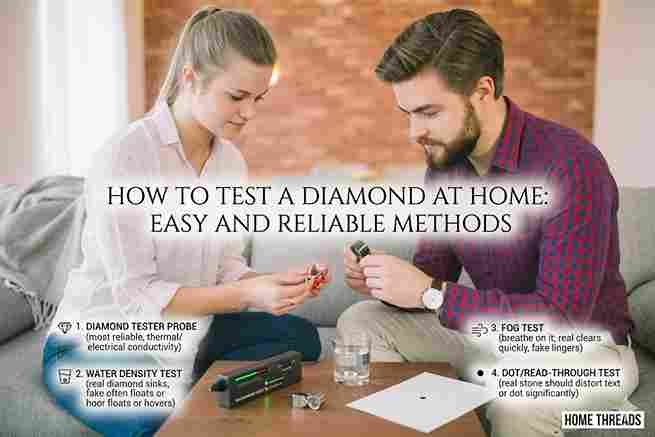
Got a diamond but unsure if it’s real? Don’t worry! You don’t need expensive tools or a professional jeweler to verify its authenticity. Learning how to test a diamond at home can save you time, money, and the stress of being scammed. In this guide, we’ll walk you through easy, reliable, and practical methods to test a diamond using common household items.
Why Test a Diamond at Home?
Understanding the Need for Diamond Testing
Testing a diamond at home is essential for many reasons. Whether you’ve inherited a piece of jewelry, purchased a new diamond, or received one as a gift, verifying its authenticity ensures peace of mind. Counterfeit or synthetic diamonds are becoming increasingly common, making it crucial to know if your stone is genuine.
Can You Accurately Test a Diamond at Home?
While at-home methods are a great starting point, they may not be 100% conclusive. These tests can provide strong indications about a diamond’s authenticity, but consulting a professional jeweler is recommended for high-value stones or final verification.
Tools and Materials You Might Need
Testing a diamond at home doesn’t require expensive equipment. Here are some common items you’ll need:
- Glass of Water: For density testing.
- Flashlight: To observe light reflection and sparkle.
- Magnifying Glass or Jeweler’s Loupe: To examine clarity and inclusions.
- White Sheet of Paper: For the dot or newspaper test.
- Lighter or Candle: For the heat test.
- UV Light: To check fluorescence.
- Sandpaper: Optional, for scratch testing.
Most of these tools are inexpensive and can be found in your home or purchased easily.
Step-by-Step Methods: How to Test a Diamond at Home
The Water Test
The water test is a quick and easy way to determine if your diamond is real.
- Fill a glass with water.
- Drop the diamond into the glass.
- Observe whether it sinks or floats.
A real diamond will sink due to its high density, while a fake diamond may float or suspend in the water.
The Fog Test
This test leverages a diamond’s excellent thermal conductivity.
- Hold the diamond close to your mouth and breathe on it to create fog.
- Watch how quickly the fog disappears.
A genuine diamond disperses heat instantly, so the fog will clear almost immediately. Fake diamonds, like cubic zirconia, will stay foggy for a few seconds.
The Scratch Test
Diamonds are one of the hardest substances on Earth, making them resistant to scratches.
- Use a piece of sandpaper or glass.
- Gently scratch the surface of the diamond with the sandpaper.
A real diamond won’t scratch, while imitation stones may show marks. Be cautious, as this test could damage the stone if it’s not a diamond.
The Light Reflection Test
This test examines how well a diamond refracts light.
- Place the diamond under a bright light source.
- Observe the light reflections and sparkle.
A real diamond creates a rainbow-like brilliance, while fake stones may appear dull or have less sparkle. However, this test may not work well for poorly cut diamonds.
The Newspaper or Dot Test
This method checks how a diamond refracts light.
- Place a piece of newspaper or a sheet with a black dot on a flat surface.
- Set the diamond flat-side down on the text or dot.
- Look through the diamond.
A genuine diamond will refract light so intensely that you won’t see the text or dot through it. Fake diamonds, however, will let you see the text or dot clearly.
The Heat Test
The heat test demonstrates a diamond’s resistance to extreme temperature changes.
- Heat the diamond with a lighter or candle for about 30 seconds.
- Drop it into cold water immediately after heating.
A real diamond will withstand the thermal shock without cracking, while fake stones, such as glass, may shatter.
The UV Light Test
Many real diamonds fluoresce under UV light, emitting a blue glow.
- Shine a UV light on the diamond in a dark room.
- Observe whether the stone glows blue or remains unchanged.
While fluorescence is common in many diamonds, its absence doesn’t necessarily mean the diamond is fake. This test is not conclusive on its own.
Differences Between Real and Synthetic Diamonds
Natural vs. Lab-Grown Diamonds
Natural diamonds are formed over millions of years under extreme heat and pressure deep within the Earth. Lab-grown diamonds have the same physical and chemical properties but are created in controlled environments over weeks or months.
Fake Diamonds
Fake diamonds, such as cubic zirconia or moissanite, may look similar to real diamonds but differ in hardness, density, and light reflection. Some may even pass certain at-home tests, making professional verification necessary.
When to Consult a Professional Jeweler
While at-home tests are helpful, there are times when consulting a jeweler is essential:
- High-Value Diamonds: Verify their authenticity and receive certifications.
- Inconclusive Results: Confirm the findings of at-home tests.
- Accurate Grading: Obtain detailed assessments of clarity, cut, and carat weight.
Professional jewelers use advanced tools like diamond testers and microscopes for precise evaluations.
Common Myths About Testing Diamonds
There are several myths surrounding diamond testing. Let’s debunk a few:
- Myth: Diamonds are indestructible. Truth: While they are extremely hard, diamonds can chip or break under extreme force.
- Myth: Only expensive equipment can identify real diamonds. Truth: Many at-home methods are effective for basic testing.
- Myth: All real diamonds fluoresce under UV light. Truth: Not all genuine diamonds exhibit fluorescence.
Advantages of Testing a Diamond at Home
Testing diamonds at home offers several benefits:
- Cost-Effective: Avoid unnecessary trips to a jeweler.
- Convenient: Use readily available household items.
- Empowering: Gain confidence in identifying real diamonds.
Learning how to test a diamond at home can provide peace of mind and help you make informed decisions about your jewelry.
Conclusion
Testing a diamond at home is easier than you might think. By using simple tools and following the methods outlined in this guide, you can confidently assess your stone’s authenticity. However, for high-value diamonds or inconclusive results, consulting a professional jeweler is always recommended.
Now that you know how to test a diamond at home, gather the tools and try these tests today. Uncover the truth about your diamond with ease!
